

A zipper looks simple — until you have to order 50,000 of them. Suddenly every millimeter matters: the torque rating on a pull tab, the stop strength under lateral load, the tape shrinkage percentage after washing. B2B buyers who understand zipper component anatomy make better sourcing decisions, negotiate more effectively, and avoid the most common procurement mistakes. This guide breaks down every component of a metal zipper — what each part does, how it's made, and what to specify when placing an order.
The 8 Essential Components of a Metal Zipper
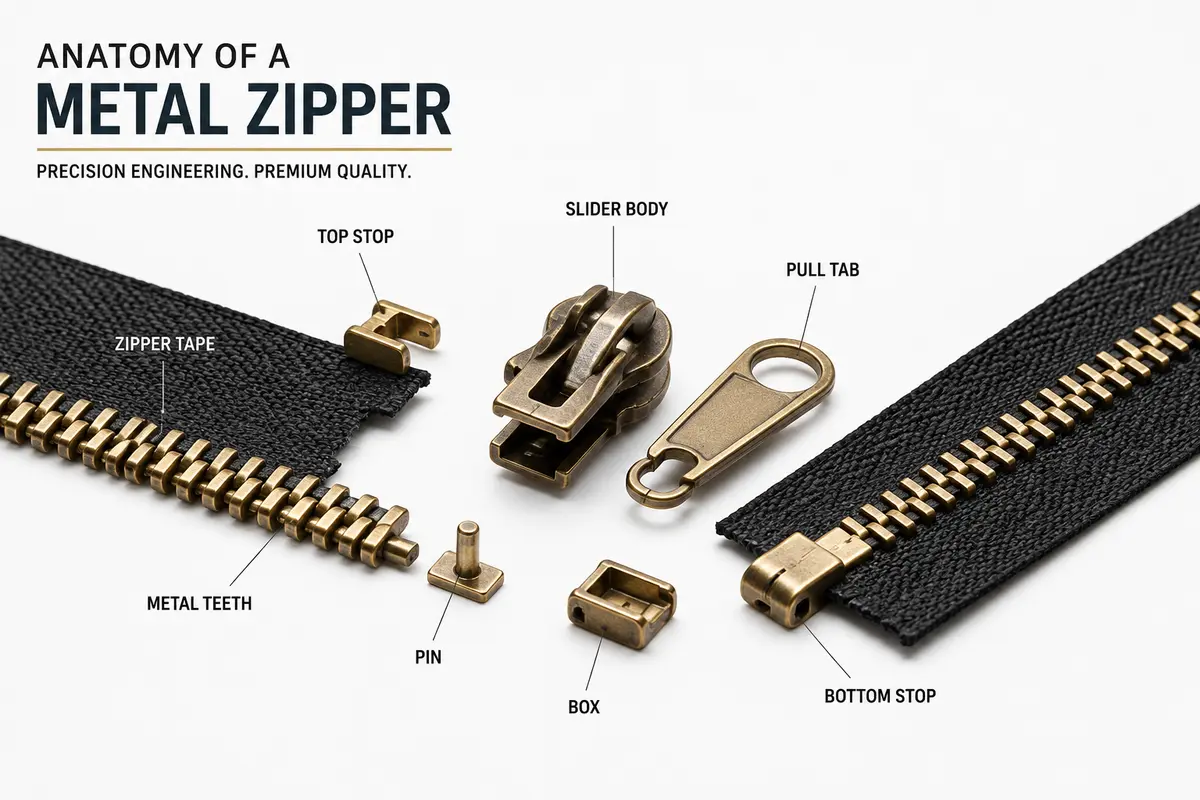
Every metal zipper — whether #3 for a dress or #10 for industrial luggage — is built from the same fundamental parts. Understanding each one lets you write precise specifications and catch quality issues before they reach your production line.
① Zipper Teeth (Chain)
Individual metal elements clamped onto tape edges. Determines strength, appearance, and gauge compatibility.
② Zipper Tape
The woven fabric strip that teeth are attached to. Material choice affects wash shrinkage, dye performance, and UV resistance.
③ Slider Body
The moving mechanism that joins and separates the two halves of teeth. Houses the locking mechanism.
④ Pull Tab (Puller)
The grip that users hold to operate the zipper. The most customization-friendly component for branding.
⑤ Top Stop
Metal clips at the top end of each tape half. Prevents the slider from running off the chain.
⑥ Bottom Stop
The anchor at the closed end. Must withstand repeated impact from the slider in daily use.
⑦ Pin & Box
The separable bottom assembly on open-end zippers. Pin inserts into the box to align both tape halves.
⑧ Reinforcement Film
Adhesive film applied to tape ends. Prevents fraying and strengthens attachment points during sewing.
1. Zipper Teeth — The Foundation of Strength
Metal zipper teeth are stamped from flat metal sheets or die-cast from alloys, then mechanically clamped onto the zipper tape at precise intervals. The three dominant metals and their characteristics:
| Metal Type | Strength | Weight | Corrosion | Best Use Case |
|---|---|---|---|---|
| Brass | ★★★★★ | Heavy | Excellent | Premium jeans, luxury bags |
| Aluminum | ★★★☆☆ | Light | Good | Lightweight jackets, sportswear |
| Zinc Alloy | ★★★★☆ | Medium | With plating | Mid-range bags, general hardware |
⚡ Procurement Tip: When ordering brass zippers, confirm the copper content. True brass (65%+ copper) develops a desirable patina over time. Low-copper brass alloys (<55% Cu) won't age the same way and may appear inconsistent across batches.
2. Zipper Tape — The Backbone You Shouldn't Overlook
Tape quality causes more batch rejections than teeth failure in high-volume garment production. The tape is what your sewing operators handle, what gets dyed to match your fabric, and what shrinks or stretches after washing.
Polyester Tape (Standard)
- Shrinkage: <1% at 60°C wash
- Dye performance: Excellent, accepts dispersion dyes
- UV resistance: Good (with UV stabilizer)
- Cost: $0.02–0.04 per meter
- Best for: 90% of applications
Cotton Tape
- Shrinkage: 3–5% — must be pre-shrunk
- Dye performance: Excellent natural dye absorption
- UV resistance: Moderate
- Cost: $0.03–0.06 per meter
- Best for: Natural fiber garments, vintage denim
Tape width varies by zipper gauge: #3 uses 12mm tape, #5 uses 15mm, #8 uses 20mm, #10 uses 25mm. Always confirm tape width when switching suppliers — ±1mm variation can affect your sewing jig alignment.
3. Slider Body & Locking Mechanism — The User's Daily Touchpoint
The slider is the most mechanically complex component. It contains the Y-channel that separates and rejoins teeth, plus (in auto-lock versions) a spring-loaded locking pin. A slider that jams or fails to lock is the #1 consumer complaint about zippers.
Slider bodies are typically die-cast zinc alloy, chosen for its ability to hold fine detail in the casting mold. Premium sliders may use brass or stainless steel. The internal Y-channel geometry must match the tooth profile exactly — a slider designed for #5 aluminum teeth will not work properly with #5 brass teeth from a different mold.
Slider Type Quick Reference
| Auto-Lock | Spring pin drops into teeth when tab released | Jeans, bags, tents |
| Non-Lock | No locking mechanism — free sliding | Lining pockets, decorative zippers |
| Pin Lock | Manual lock — user presses tab to engage | Jackets, coats, footwear |
| Reversible | Works from both fabric sides | Reversible garments, sleeping bags |
4. Pull Tab (Puller) — Your Brand's Signature
The pull tab is the most visible, most touched, and most customizable zipper component. A well-designed puller communicates brand quality before the customer even looks at the label. OEM pull tabs can feature:
- Custom shapes: Die-cast logos, geometric designs, animal silhouettes — limited only by mold design, not by the zipper itself.
- Surface finishes: Electroplated nickel, brass, gunmetal, rose gold, or painted colors matched to Pantone specifications.
- Embossing & engraving: Brand names, logos, or patterns laser-engraved or embossed into the tab surface.
- Multi-material: Rubber coating over zinc body for soft-touch grip, leather inserts on luxury bags, or transparent acrylic for fashion.
⚡ Procurement Tip: Custom pull tab molds cost $200–800 (one-time) depending on complexity. At volumes above 10,000 units, the mold cost amortizes to under $0.08 per zipper — an inexpensive branding investment compared to custom labels or hang tags.
5. Top Stops & Bottom Stops — The Small Parts That Prevent Big Failures
Top and bottom stops are small U-shaped metal clips crimped onto the zipper tape. They look trivial but their failure mode is catastrophic: the slider runs off the chain entirely, requiring replacement of the whole zipper.
Key quality indicators for stops:
- Clamping force: Top stops must withstand ≥60N pull-off force (#5 zipper standard). Test by pulling the slider against the stop at maximum force.
- Material match: Stops should be the same base metal as teeth to avoid galvanic corrosion. Brass stops on brass teeth; zinc stops on zinc teeth.
- Edge finish: Sharp edges on stamped stops can cut fabric or scratch end users. Quality stops have rolled or deburred edges.
6. Pin & Box — The Separable Bottom Joint
On open-end (separating) zippers used in jackets and coats, the pin-and-box assembly lets the two halves detach completely. The pin (a reinforced metal tip on one tape half) inserts into the box (a hollow housing on the other half), and the slider travels over both to engage the teeth.
Common Pin & Box Failure Modes
- Pin bending: Occurs when pin material is too soft for the zipper gauge. Solution: specify hardened brass or steel pins for #8 and above.
- Box cracking: Die-cast zinc boxes can crack under repeated insertion stress. Solution: forged brass boxes for heavy-duty applications.
- Misalignment: Pin doesn't seat smoothly in box. Caused by ±0.15mm+ dimensional variation. Solution: specify ±0.05mm tolerance.
How to Write a Better Zipper Specification
Most B2B zipper orders are written like this: "#5 metal zipper, 60cm, black." This specification leaves too much room for interpretation. A comprehensive specification should cover every component:
ZIPPER SPECIFICATION — Template

Type:           Open-end metal zipper, auto-lock
Gauge:          #5 (tooth width 6.0mm ±0.1mm)
Teeth Material: Brass (Cu ≥65%), nickel-plated
Tape Material:  Polyester, black, 15mm width
Tape Shrinkage: ≤1% at 60°C
Slider:         Zinc alloy die-cast, auto-lock
Slider Finish:  Nickel electroplated, 3μm min
Pull Tab:       Standard teardrop, 22mm length
Top Stops:      Brass, U-clamp, deburred edges
Bottom Stop:    Brass, one-piece forged
Pin & Box:      Brass pin, zinc box (standard)
Length:         600mm ±3mm (from top stop to bottom stop)
Salt Spray:     24h NSS, no white rust
Packaging:      100 pcs/bundle, 50 bundles/carton
A specification this detailed achieves three things: it gives your supplier clear production targets, it serves as a quality inspection checklist upon delivery, and it protects you in case of disputes — because the spec, not a verbal promise, defines what was ordered.
Ready to Source Metal Zippers with Confidence?
Browse our complete metal zipper catalog with detailed component specifications for every product. Request free samples to test teeth hardness, slider smoothness, and stop strength before placing your bulk order. Our team can help you write a custom specification that matches your exact requirements.
Explore Metal Zippers →